







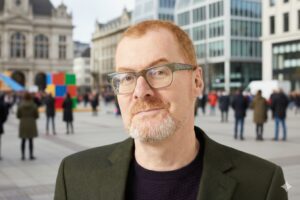
About Tim Jones Founder-Director, TJ Culture
Tim Jones is a cultural strategist and broker with over 20 years’ experience connecting the commercial, cultural and civic sectors in the UK and internationally. He has developed cultural strategies for major sites including Heathrow Airport, Wembley Park and Boston’s ‘Avenue of the Arts’. From 2018–23 Tim led the City of London’s Culture Mile – a landmark cultural district project built with the Barbican, Museum of London, Guildhall School and London Symphony Orchestra. Tim has pioneered a Cultural Planning Framework in the Square Mile embedding arts contributions into developer obligations. He creates portfolio-wide public art strategies for major developers, as well as providing strategies and opportunity audits for schemes and masterplans, through his company TJ Culture. Tim will be speaking at The Impact of Culture in the City on 18 Nov.
On the morning of 10 August, Belfast woke with a sore head and a remarkable piece of evidence. Over eight days the Fleadh drew 1.65 million visits to the city centre. Licences were approved at speed, the city centre was pedestrianised, and agencies that rarely share a table found themselves sharing a timetable. The obvious question is: what to do with that evidence before the Fleadh returns on 1 August 2027?
Let’s start with why it worked. Nobody travelled to Belfast in August for the pavements or the retail mix. They came for music played by people who meant it, in a place that could only be this one. That is what culture supplies — the excitement, the footfall, the pride, the distinctiveness that can’t be bought in and installed — and it’s why the hotels, the bars, the taxis and the shops had the week they had. Culture isn’t decoration applied to a great place; it’s one of the load-bearing ingredients.
Now look five weeks on. Culture Night returned with more than 200 free events, and one of the people behind it called the arts sector in Belfast “on its knees”. It went ahead thanks to Belfast City Council funding with additional support from Linen Quarter and Cathedral Quarter BIDs. Arts investment in Northern Ireland runs at roughly £5 a head, about half the Welsh figure and a quarter of the Republic’s. That’s the gap worth minding: what the city can stage, against what it can sustain.
Picture three territories that rarely share a map. The city holds the planning powers, the transport and the public squares. The cultural sector holds the imagination, the audiences and the willingness to try things that might not work. The commercial sector holds the capital, the pace and — where landowners stay — the patience of decades, and it runs well beyond property, into hospitality, retail, transport and the firms whose trade rises and falls with how the city feels. The borders blur, too: a session in a bar is culture, hospitality and commerce at once, and a screen sector worth £477m to the regional economy since 2022 shows how commercial culture can be.
The ground where all three — culture, commercial, city — meet is where places become worth caring about. And yet nobody is employed to occupy it.
That emptiness is structural rather than a decision anyone made: each sector turns up to the corner it knows, speaks the language it is paid to speak, and reports back to its own board. Nobody stands in the middle, so the place falls between three sets of priorities.
Pedestrianisation is the live test. Everyone agrees it made the Fleadh work. Politicians want a review. The Infrastructure Minister would support it “if it works for the community”, and disability campaigners warn that doing it badly would shut people out of their own city. No sector can take that decision well alone; it is exactly what the middle ground exists to hold.
So what would Belfast be buying, beyond another good party in August? It’s not about eight days of extraordinary trade against fifty-two weeks of ordinary trade. The prize is the ordinary weeks, lifted. It’s the graduate who stays because the place is interesting in February as well as August, and the investor who picks Belfast over a comparable city because it feels alive. It’s a cultural sector solid enough to deliver 2027 without heroics.
The Economy Minister, who put an initial £53m of additional spend on the week, asked the right question: how do we make sure people can experience that all the time? Without a middle ground the answer is that they can’t, and 2027 is organised the way 2026 was — heroically, at the last minute, by people who then disperse.
So the question is not whether Belfast can host another Fleadh. It plainly can. But who, between now and next August, is prepared to stand in the middle, and what would keep them there. The answer is less glamorous than a new institution and harder to deliver, because it depends on three sectors sharing credit — the scarcest resource any city has.
On 18 November I’ll be in Belfast as Keynote speaker at The Impact of Culture in the City, to explore what that middle ground looks like, and who might already be standing in it. I’d like to hear from those who are, or would be prepared to be.
THE IMPACT OF CULTURE IN THE CITY
Join us on 18 November, 10 AM – 1 PM
As our towns and cities face growing social, economic and environmental challenges, understanding the role of culture as a catalyst for placemaking has never been more important. From public art and creative programming to heritage, music, storytelling and cultural experiences, culture transforms spaces into places, where people want to live, learn, work, visit and invest.
Sign up to our newsletter